
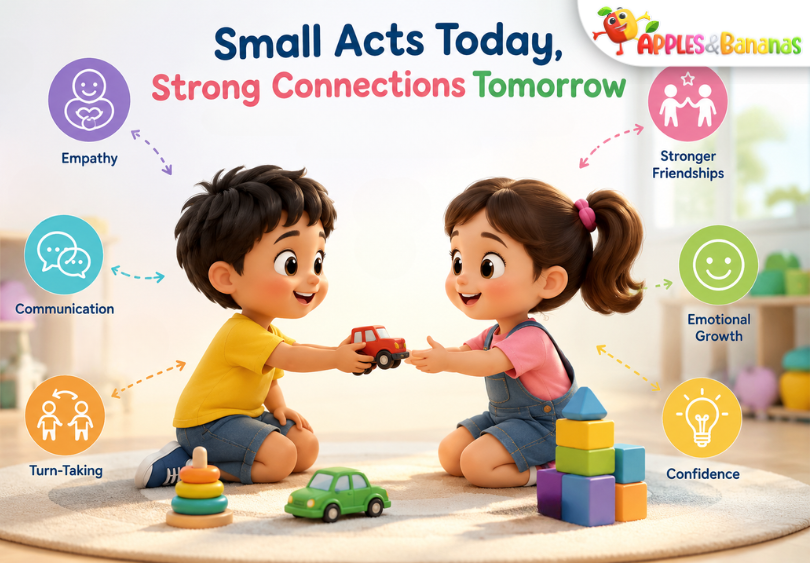
Teaching young children how to share is one of the most essential lessons you’ll ever support them with. Sharing builds social skills, empathy, communication and turn-taking abilities; all fundamental aspects of early childhood growth. According to child development research, the early years (birth to around 5 years) are a foundation for lifelong social and emotional learning.
In this blog, we’ll walk through effective strategies, real-world examples and expert-approved tips to help your little one grow into a thoughtful, confident and compassionate sharer.
Why Teaching Sharing Matters
Sharing is a fundamental aspect of prosocial behavior, alongside helping and cooperation.
For infants and toddlers, sharing often starts with simple exchanges (like giving a toy to a parent). As children grow, they begin to understand empathy and fairness, which deepens their willingness to share.
Start with Modeling Behavior
Kids learn by watching the adults around them. When you share your snacks, books or even your attention during playtime, you send a powerful message: sharing is normal and kind.
Parenting experts often emphasize modeling gentle behavior as the first step to helping kids learn to share naturally
Tips for parents:
- Narrate your actions out loud, simple statements like ‘I’m sharing my cookie so we can both enjoy it’ help children understand what sharing looks like in real life
- Take turns with a toy while your child watches
Use Play & Turn-Taking Games
Before children fully grasp “sharing,” they understand turn-taking; a great stepping-stone. Simple games like rolling a ball back and forth or taking turns with blocks can make sharing feel fun and achievable.
Encourage Empathy & Communication
When your child hesitates to share, use gentle language like:
“How does it make you feel when someone shares their toy with you?”
This helps them connect sharing to empathy and positive feelings about others
Talk about emotions:
- “See how sharing your toy brings a smile to your friend’s face.”
- “This toy is special to you, and it was very kind of you to share it.”
Read Stories About Sharing
Children’s books are powerful tools. Reading together not only builds language skills but also reinforces why sharing matters. You can pair storytelling with real-life practice during playtime or lunch
Keep Realistic Expectations
Expecting a 1-year-old to freely share every toy isn’t developmentally realistic. At this age, toddlers are still learning about ownership and emotions. Gradually, through practice and encouragement, they’ll become more open to sharing
Key practice rule:
- Do not force sharing, encouragement works far better than pressure or punishment
Use Positive Reinforcement
Praise goes a long way! When your child shares, even in small ways acknowledge it:
“You let your friend use your toy, and that was very thoughtful.”
This reinforces that sharing feels good not just for others, but for themselves too.
Turn Challenges Into Problem-Solving Moments
When conflicts happen (and they will!), use the moment to teach negotiation and patience:
- Suggest taking turns with a timer
- Offer choices (“Would you rather share your toy or your crayons?”)
These strategies help build communication and problem-solving skills alongside sharing
Further Insight: Child Social Development
If you’re curious about the science behind how children grow socially and emotionally, check out this overview of child development on Wikipedia. It explains how young children’s ability to interact, communicate and build relationships evolves as they grow.
Expert Parenting Resource
For more expert-backed tips on sharing and other social skills, explore this comprehensive guide on teaching kids to share from Raising Children, a well-known parenting resource that covers behavior, emotional development and practical strategies for families: https://raisingchildren.net.au/toddlers/behaviour/friends-siblings/sharing
Teaching sharing isn’t a one-time lesson. It’s an ongoing journey woven into daily interactions, playtime, meals and friendships. With patience, positive modeling and strategic guidance, you can help your child build essential social skills that last a lifetime.
Sharing teaches empathy, builds confidence and helps children connect meaningfully with others.
More About Apples & Bananas
Apples & Bananas is an interactive learning app where kids can enjoy a variety of exciting games, engaging videos, nursery rhymes, songs, soothing lullabies, and much more. Every feature is thoughtfully created by experts to help children adapt to the ever-changing world, while having fun. We are COPPA compliant, ensuring a safe and secure environment where your child can learn and grow with confidence.
Download the app now and unlock a world where learning meets imagination.