
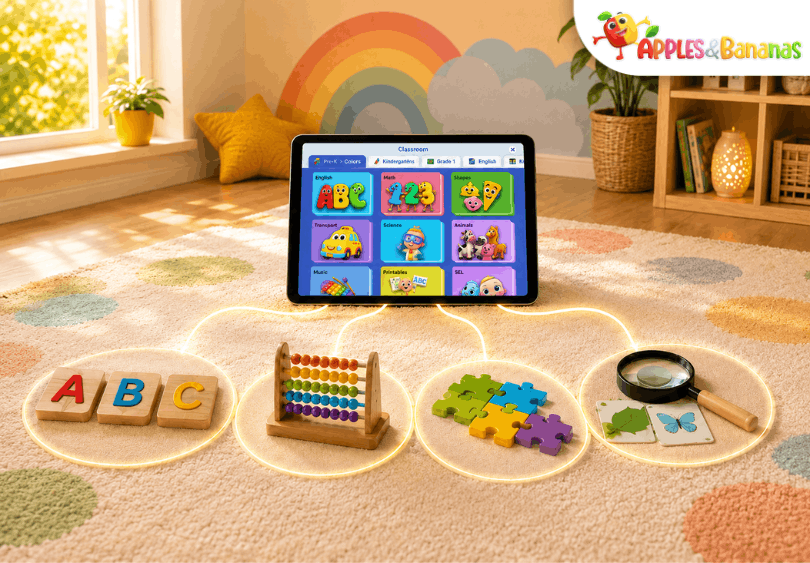
In today’s digital world, parents are constantly searching for effective ways to help children learn while having fun. One educational approach that continues to gain popularity is game-based learning. Research shows that children learn best when they are actively engaged, curious, and enjoying the process.
As technologies such as Artificial Intelligence (AI), adaptive learning, personalized education, interactive learning apps and educational gamification become increasingly popular, learning through games has emerged as one of the most effective methods for supporting a child’s cognitive, social, emotional and academic development.
Whether it’s solving puzzles, matching letters, identifying shapes, practicing math skills or exploring science concepts, educational games transform learning into an exciting adventure.
What Is Learning Through Games?
Learning through games, often called game-based learning, is an educational approach that uses play and interactive activities to teach concepts and skills. Instead of passively receiving information, children actively participate in learning experiences.
Game-based learning is closely related to the concept of play, which has long been recognized as essential to child development.
Why Games Work So Well for Children’s Development
1. Games Increase Engagement and Motivation
Children naturally love to play. When learning is presented as a game, children are more likely to stay focused and motivated.
Game elements such as:
- Rewards
- Levels
- Challenges
- Progress tracking
- Interactive feedback
encourage children to keep practicing and learning without feeling pressured.
This increased engagement often leads to better learning outcomes and longer attention spans.
2. Games Support Cognitive Development
Educational games help strengthen important cognitive skills including:
- Memory
- Problem-solving
- Critical thinking
- Decision-making
- Pattern recognition
- Logical reasoning
For example, puzzle games encourage children to think strategically, while matching games improve memory and concentration.
These skills form the foundation for success in mathematics, science, reading, and everyday life.
3. Games Encourage Active Learning
Traditional learning often involves listening and memorizing. In contrast, games require children to:
- Explore
- Experiment
- Make choices
- Learn from mistakes
- Discover solutions independently
This active participation helps children retain information more effectively and develop confidence in their abilities.
4. Games Build Social and Emotional Skills
Many educational games encourage:
- Cooperation
- Sharing
- Communication
- Turn-taking
- Empathy
- Emotional regulation
Children learn how to manage challenges, celebrate achievements and develop resilience when things do not go as planned.
These social-emotional learning (SEL) skills are increasingly recognized as essential for long-term success.
5. Games Support Personalized Learning
One of the biggest advantages of modern educational technology is personalization.
Learning platforms can:
- Adapt difficulty levels
- Identify strengths and weaknesses
- Provide customized learning paths
- Offer real-time feedback
This ensures that children learn at a pace that matches their developmental needs.
Personalized learning is one of the fastest-growing trends in education technology today.
How the Apples & Bananas App Supports Learning Through Games
The Apples & Bananas App combines education and entertainment through a variety of interactive learning experiences designed for young children.
The app helps children learn through:
- Interactive Educational Games – Children can practice foundational skills while having fun
- Early Literacy Activities – Letter recognition, phonics, vocabulary building and reading readiness activities support language development
- Mathematics Learning Games – Counting, number recognition, patterns, sorting and problem-solving activities help develop early math skills
- Cognitive Development Activities – Memory games, matching activities, puzzles and logic challenges strengthen critical thinking skills
- Creativity and Exploration – Children can explore, discover and learn independently in a safe and engaging environment
- Age-Appropriate Learning – Activities are designed to support developmental milestones for children across different age groups
By combining game-based learning principles with engaging educational content, the Apples & Bananas App helps children develop important academic, cognitive and social-emotional skills while enjoying the learning process.
Benefits of Learning Through Games at a Glance
- Improves memory and concentration
- Enhances problem-solving abilities
- Builds critical thinking skills
- Encourages creativity
- Supports emotional development
- Promotes independent learning
- Increases motivation and engagement
- Strengthens literacy and numeracy skills
- Supports personalized learning experiences
- Makes education enjoyable and stress-free
Learning through games is far more than entertainment, it’s a powerful educational tool that supports a child’s overall development. As AI-powered educational technology continues to evolve, game-based learning is becoming one of the most effective ways to help children build foundational skills while maintaining curiosity and enthusiasm for learning.
Educational platforms such as the Apples & Bananas App demonstrate how interactive games, personalized learning experiences and engaging activities can help children learn, grow and thrive in today’s digital world. When children are having fun, they are often learning their best.
Frequently Asked Questions (FAQs)
1. What is game-based learning?
Game-based learning is an educational approach that uses games and playful activities to teach academic, cognitive, social and emotional skills in an engaging way.
2. How do educational games help child development?
Educational games improve memory, concentration, problem-solving, critical thinking, creativity and social-emotional skills while making learning enjoyable.
3. Is game-based learning effective for young children?
Yes. Research consistently shows that young children learn effectively through play because it encourages active participation, exploration and hands-on learning.
4. How does AI improve educational games?
AI can personalize learning experiences, adapt difficulty levels, provide instant feedback, and track progress to help children learn more efficiently.
5. How does the Apples & Bananas App support learning?
The Apples & Bananas App offers interactive educational games, literacy activities, math learning, cognitive development exercises and age-appropriate content designed to support children’s overall growth.
More About Apples & Bananas
Apples & Bananas is an interactive learning app where kids can enjoy a variety of exciting games, engaging videos, nursery rhymes, songs, soothing lullabies, and much more. Every feature is thoughtfully created by experts to help children adapt to the ever-changing world, while having fun. We are COPPA compliant, ensuring a safe and secure environment where your child can learn and grow with confidence.
Download the app now and unlock a world where learning meets imagination.