Quick answer: Screen time isn’t simply good or bad what matters most is the type of content, how it’s used and whether a parent is involved. Not all screen time is equal. Engaging, purposeful content can actually support how young children learn and develop language but aimless or background screen exposure, especially in the first two years of life, offers minimal benefit.
If you’ve ever felt a wave of guilt handing your toddler a tablet, you’re not alone. Screen time has become one of the most loaded topics in modern parenting and the advice parents receive is often confusing, contradictory and frankly, a little judgemental.
The truth is more nuanced than “screens are bad.” As a parent, you deserve a clear, honest picture of what the research actually shows so you can make the right call for your family without the guilt trip.
What the Guidelines Actually Say
Most major health organizations, including the World Health Organization and the American Academy of Paediatrics, offer the following broad guidance:
- Under 18 months: Avoid screen time other than video calls (like FaceTime with grandparents)
- 18–24 months: If introduced, choose high-quality content and watch together with your child
- 2–5 years: Limit to around 1 hour per day of high-quality programming
- 6 years and older: Set consistent limits on time and ensure screens don’t displace sleep, physical activity or family time
These are guidelines, not rules and they’re intended for average situations, not every family. A child who watches 70 minutes of an excellent educational programme while sitting with a parent is having a very different experience from one who watches 70 minutes of random videos alone.
The Problem Isn’t Screens It’s Passive, Unstructured Screen Time
Here’s the distinction that matters most and one that often gets lost in the debate:
Research consistently shows that passive screen time content that a child watches without interacting, without a parent present and without connection to real-world learning offers little developmental benefit and can displace more valuable activities like play, conversation and reading.
But interactive, high-quality screen time tells a different story:
- A 2019 study in JAMA Paediatrics found that children who used educational apps with parental involvement showed stronger language gains than those who used apps alone
- Video calls with family members have been shown to support language development even in very young children because the interaction is real and responsive
- Educational programmes with slow pacing, clear narration and repetition designed specifically for young children have demonstrated measurable literacy and numeracy benefits
The key word across all of this is quality. Not all screen time is equal and treating it as one thing is where a lot of the confusion starts.
What Makes Screen Time High Quality for Young Children?
If you’re choosing apps, programmes or videos for your child, here are the qualities that actually matter:
- Interactive rather than passive – the child responds, taps, chooses or participates rather than just watching
- Age-appropriate pacing – slow, clear and not overstimulating. Fast cuts, flashing lights and loud sound effects are entertainment, not education
- Ad-free and safe – young children cannot distinguish between content and advertising. Apps with ads or in-app purchases aren’t appropriate for toddlers
- COPPA-compliant – this means the app has been designed with children’s privacy and safety as a legal requirement, not an afterthought
- Designed around learning goals – look for content built around phonics, numeracy, language or specific developmental skills, not just general entertainment
- Co-viewing friendly – the best apps and programmes work well when a parent and child use them together
Parental involvement is the real game-changer
This might be the most important thing in this entire post: your involvement transforms what screen time does for your child.
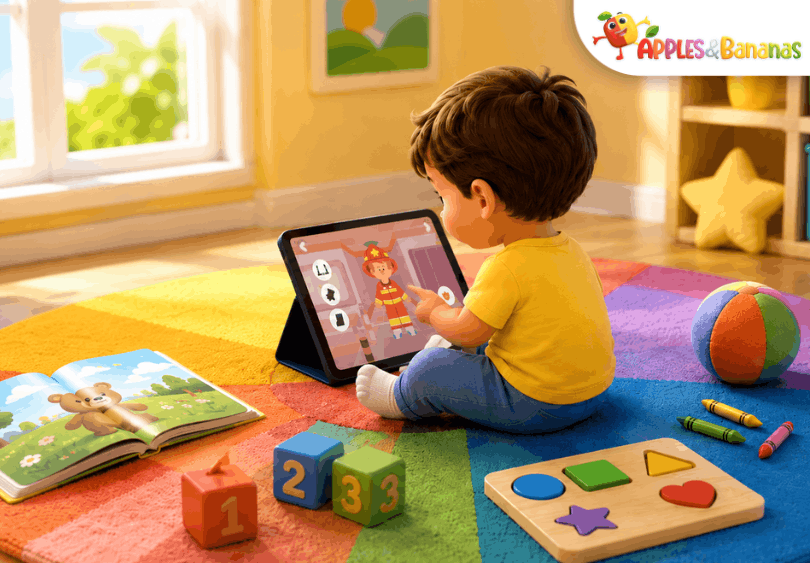
Research on what’s sometimes called “joint media engagement” shows that when parents watch, play or interact alongside their child during screen time asking questions, naming things on screen, connecting it to real life children learn significantly more than when they use screens alone.
You don’t need to hover over every minute. Even brief moments of engagement like pointing out “Look, she’s counting the apples! Can you count with her?” turn passive watching into active learning.
So, Can Screen Time Actually Be Good for Kids?
Yes. When children engage with high-quality, age-appropriate content, screen time can support learning, creativity, and skill development. The key is choosing content carefully and whenever possible, being involved in the experience alongside your child.
What it shouldn’t do is replace reading together, outdoor play, conversation or physical activity. Used as one part of a varied day, quality screen time earns its place.
This thinking is exactly what guided the creation of the Apples & Bananas Kids Learning App. It’s completely ad-free, COPPA-compliant and designed for children aged 2–6 with interactive activities across math, phonics, language, science and more. It works beautifully as a co-viewing experience but is also designed to be used independently by older preschoolers.
If you want screen time that actually works for your child, Apples & Bananas is available to download free on the App Store and Google Play.
👉 Also worth reading: Why Puzzles Are One of the Best Things You Can Do for Your Toddler’s Brain | How Stories and Songs Build Language Skills in Young Children
Frequently Asked Questions
Q: How much screen time is too much for a 2-year-old?
A: Most guidelines suggest around 1 hour per day of high-quality content for children aged 2–5. But the type of content and whether you’re engaged alongside them matters as much as the total time. A child who watches 45 minutes of an interactive educational app with a parent is having a more beneficial experience than one watching 20 minutes of fast-paced, ad-filled videos alone.
Q: Is it okay for babies under 1 to watch TV?
A: Most health guidelines recommend avoiding screen time for children under 18 months, with the exception of video calls. Very young babies don’t yet have the developmental capacity to process or learn from 2D screens the way older children do, and screen time at this age can displace the face-to-face interaction that’s most important for early development.
Q: Are educational apps actually educational?
A: Some are, some aren’t – and the label “educational” on an app store listing means very little on its own. Look for apps that are interactive (not just videos), age-appropriate, ad-free and built around specific learning goals like phonics, counting or vocabulary. Reading independent reviews and checking for COPPA compliance is a good starting point.
Q: My child has a meltdown when I turn off the screen. Is this normal?
A: Very normal and it doesn’t mean your child is addicted. Screens are stimulating and transitions away from stimulating activities are genuinely hard for young children whose emotional regulation is still developing. Giving a 5-minute warning, using a consistent routine around screen time and having an engaging activity ready to transition to can all help reduce the intensity of these moments.
Q: Does screen time affect sleep?
A: It can, particularly if screens are used in the hour before bed. The blue light emitted by screens can interfere with melatonin production, making it harder to fall asleep. Fast-paced or stimulating content can also make it harder for children to wind down. Most sleep experts recommend screen-free time in the 30–60 minutes before bedtime as part of a calming routine.
More About Apples & Bananas
Apples & Bananas is an interactive learning app where kids can enjoy a variety of exciting games, engaging videos, nursery rhymes, songs, soothing lullabies, and much more. Every feature is thoughtfully created by experts to help children adapt to the ever-changing world, while having fun. We are COPPA compliant, ensuring a safe and secure environment where your child can learn and grow with confidence.
Download the app now and unlock a world where learning meets imagination.